Don't Buy Until You Read This: Samsung Q750F vs Marshall Middleton II
The consumer audio market has evolved into a landscape defined by specialization. A decade ago, a "speaker" was a relatively simple proposition, but today, buyers must choose between ecosystem-integrated home theater components and high-fidelity portable monitors. This comparison between the Samsung Q750F (a sophisticated soundbar system) and the Marshall Middleton II (a premium portable Bluetooth speaker) highlights the fundamental divide in modern audio design. While both sit at a similar premium price bracket, they serve entirely different masters: the living room and the open road. Understanding which one fits your lifestyle requires looking past the brand names and diving into the engineering priorities that define their performance.
Selecting the right audio equipment often involves trade-offs between convenience and immersion. The Samsung Q750F is designed to be the invisible heart of a home entertainment setup, focusing on spatial audio and cinematic depth. In contrast, the Marshall Middleton II is a piece of industrial art designed for the individual who values tactile controls, rugged reliability, and the ability to bring high-quality sound wherever they go. This article breaks down every technical and practical aspect of these two heavyweights to ensure you invest your money in the device that actually solves your audio needs.
Advanced Home Audio: A Deep Dive into the Samsung Q750F
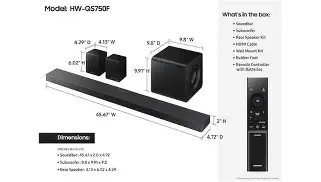
The Samsung Q750F represents a high-water mark for the brand’s mid-to-high-tier soundbar offerings. It is not just a single speaker but a synchronized multi-component system consisting of a main soundbar unit, a wireless subwoofer, and, in many regional configurations, dedicated rear satellite speakers. The engineering focus here is firmly on the "Q-Symphony" experience, which allows the soundbar to work in tandem with the speakers of a compatible Samsung television. This integration creates a massive soundstage that transcends the physical dimensions of the bar itself.
One of the standout features of the Q750F is its support for object-based audio formats like Dolby Atmos and DTS:X. Using upward-firing drivers, the system bounces sound off the ceiling to create an overhead channel. In a real-world living room environment, this means that while watching an action sequence, the sound of a helicopter feels as though it is hovering above your coffee table rather than just playing from the front of the room. The system also utilizes SpaceFit Sound technology, which uses built-in microphones to analyze the acoustics of your room and automatically calibrate the EQ settings to compensate for furniture, curtains, or open spaces that might otherwise cause audio distortion.
For the average user, the Q750F solves the problem of "muddy" dialogue. Many modern television shows are mixed with high dynamic range, which often results in music and explosions drowning out speech. Samsung’s Active Voice Amplifier (AVA) specifically targets human vocal frequencies, ensuring that whispers are heard clearly even during a loud background score. This makes it an ideal choice for households that enjoy varied content, from late-night news and talk shows to blockbuster cinema.
Pros and Cons of the Samsung Q750F
- The dedicated wireless subwoofer provides deep, cinematic bass that a portable speaker simply cannot replicate due to physical enclosure limits.
- Dolby Atmos and DTS:X support offers a true 3D audio experience that is perfect for movie enthusiasts and gamers.
- Seamless integration with Samsung TV ecosystems allows for synchronized volume control and enhanced soundstage through Q-Symphony.
- Voice Assistant compatibility (Alexa/Google Assistant) makes it a functional hub for a smart home environment.
- The specialized "Game Mode Pro" optimizes sound for latency and directional accuracy, providing a competitive edge in console gaming.
- Large physical footprint; requires a dedicated TV console and several power outlets for the bar, sub, and satellites.
- Lacks portability entirely; once it is set up and calibrated, moving it to another room is a significant chore.
- Optimal performance is heavily dependent on room acoustics and ceiling height for upward-firing driver reflection.
- Over-reliance on the Samsung ecosystem for the most advanced features, which may frustrate owners of other TV brands.
The Rock 'n' Roll Portable: Analyzing the Marshall Middleton II
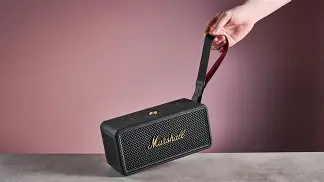
The Marshall Middleton II takes an entirely different approach to audio. While Samsung builds a wall of sound, Marshall builds a cube of power. The Middleton II is the successor to one of the most beloved portable speakers in the world, maintaining the iconic aesthetic of a vintage guitar amplifier while packing in modern "Stack Mode" technology and quad-driver architecture. It is designed for the listener who wants their music to be physical, loud, and personal.
The Middleton II utilizes what Marshall calls "True Stereophonic," a unique form of multi-directional stereo sound. By placing drivers on the front, back, and sides, the speaker creates a 360-degree field of sound that minimizes "dead spots" in a room or an outdoor setting. Whether you are behind the speaker or in front of it, the tonal balance remains remarkably consistent. This makes it a social speaker—perfect for gatherings where people are moving around rather than sitting in a fixed "sweet spot" in front of a TV.
Looking for the best Audio & Headphones deals on Amazon?
View Offers →Durability is the second pillar of the Middleton II’s design. With an IP67 rating, it is both dust-tight and waterproof. It can withstand being submerged in a meter of water for up to 30 minutes, meaning it is just as comfortable at a poolside party as it is in a dusty workshop or on a rainy camping trip. The battery life is also industry-leading, often exceeding 20 hours on a single charge, and it features a power bank function that allows you to charge your phone via the USB-C port—a lifesaver during long outdoor excursions.
From a sound perspective, the Middleton II favors a "V-shaped" sound signature with a punchy low end and crisp highs. It excels with guitar-heavy tracks, jazz, and hip-hop, where the separation between the drums and the melody is vital. The top-mounted brass controls for bass and treble are not just for show; they offer tactile, analog-style customization that allows the user to adjust to their environment on the fly without needing to open a smartphone app.
Pros and Cons of the Marshall Middleton II
- Exceptional portability and ruggedness with IP67 rating, making it suitable for almost any environment or weather condition.
- True Stereophonic 360-degree sound ensures a consistent listening experience for everyone in the vicinity.
- Impressive battery life and power bank capabilities provide utility beyond just playing music.
- Iconic Marshall design aesthetic that doubles as a piece of interior decor or a rugged outdoor tool.
- Stack Mode allows you to wirelessly connect multiple Middleton II units for a synchronized, much larger sound system.
- Lacks the wide channel separation and height effects of a dedicated soundbar system for cinematic content.
- No HDMI eARC or optical inputs; it is strictly a Bluetooth and 3.5mm auxiliary device, limiting its use with TVs.
- Mono-centric design means that while it is stereo, the physical distance between drivers is small, limiting the "width" of the soundstage.
- The high price point is partly due to the brand and materials, which might offer less raw wattage per dollar compared to larger stationary sets.
Head-to-Head Comparison
To help visualize how these two systems differ in their core specifications and intended roles, the following table compares the essential metrics that buyers should consider.
| Feature | Samsung Q750F | Marshall Middleton II |
|---|---|---|
| Primary Use | Home Theater & Living Room | Portable High-Fidelity & Outdoors |
| Audio Channels | 5.1.2 Surround Capability | Quad-Driver Stereo (360°) |
| Connectivity | HDMI eARC, Optical, Wi-Fi, Bluetooth | Bluetooth 5.2, 3.5mm Aux |
| Sound Formats | Dolby Atmos, DTS:X, Hi-Res Audio | Standard Stereo, AptX Support |
| Portability | None (Fixed Installation) | High (Integrated Carry Strap) |
| Durability | Indoor Use Only | IP67 Waterproof & Dustproof |
| Power Source | AC Power Outlets (Multiple) | Internal Battery (20+ Hours) |
The Buying Guide: Which Audio Solution Fits Your Life?
Choosing between the Samsung Q750F and the Marshall Middleton II isn't about which speaker is "better"—it's about identifying your primary listening context. To make the right choice, you should evaluate your daily habits across three main categories: environment, content type, and flexibility.
1. Evaluating Your Listening Environment
If you live in an apartment where your primary entertainment happens on a couch in front of a 4K screen, the Samsung Q750F is the logical choice. It is designed to inhabit that space permanently. The setup process involves hiding wires and positioning the subwoofer for optimal bass response. Once installed, it becomes an extension of your home's architecture. Conversely, if you lead an active lifestyle—spending weekends at the beach, hosting backyard barbecues, or moving your workstation from the kitchen to the bedroom—the Marshall Middleton II is far superior. Its small footprint and battery-powered nature mean it follows you, rather than you having to stay in its "zone."
2. Prioritizing Content: Movies vs. Music
Content is king in the world of audio. The Samsung Q750F is a cinematic tool. If you watch a lot of Netflix, Disney+, or play cinematic games like "The Last of Us" or "Call of Duty," the spatial awareness provided by Atmos is transformative. It allows you to hear the environment of the movie. However, if your primary usage is streaming Spotify, Tidal, or Apple Music, the Marshall Middleton II often provides a more "musical" experience. Marshall’s tuning is legendary for emphasizing the warmth of instruments. While the Samsung is great for music, it can sometimes sound a bit clinical or overly processed compared to the raw, analog-feeling punch of the Middleton II.
Find top-rated Audio & Headphones products at great prices.
Browse Now →3. The Ecosystem Factor
Connectivity should also drive your decision. The Samsung Q750F relies on HDMI eARC to get the best quality from your TV. It supports Wi-Fi streaming via Spotify Connect or AirPlay 2, which allows for higher-quality audio than Bluetooth. The Marshall Middleton II is simpler; it’s a "grab and go" device. It pairs with your phone in seconds. If you want a "set it and forget it" system that turns on automatically with your TV, go with Samsung. If you want a speaker that you can toss in a backpack and use as a power bank when your phone dies, the Marshall is the clear winner.
Real-World Use Cases
Consider the "Saturday Afternoon" test for both products. On a Saturday afternoon with the Samsung Q750F, you are likely sitting down to watch a Premier League match or a high-definition movie. The crowd noise swells around you, the roar of the stadium feels like it's coming from the corners of your room, and you don't even think about the speakers because they are doing their job perfectly. You aren't touching any buttons; you're just immersed in the media.
On a Saturday afternoon with the Marshall Middleton II, you might be out on the deck washing your car or prepping a grill. The speaker is sitting on a nearby table, exposed to the sun and perhaps a few splashes of water. You reach over with wet hands to crank the physical brass bass knob because your favorite rock anthem just started playing. You can feel the vibration of the music through the sturdy silicone casing. Later that evening, you bring that same speaker inside and put it on a bookshelf, where it looks like a piece of high-end design while providing ambient background music for dinner.
Conclusion
The decision between the Samsung Q750F and the Marshall Middleton II boils down to a choice between immersion and freedom. The Samsung Q750F is a powerhouse of digital signal processing and spatial engineering, designed to turn your living room into a private cinema. It excels at delivering a complex, multi-layered audio environment that makes modern media feel alive. It is an investment in your home's permanent entertainment infrastructure.
The Marshall Middleton II, on the other hand, is an investment in your lifestyle. It offers a rugged, high-fidelity companion that sounds incredible regardless of where it is placed. It sacrifices the 3D "height" of Atmos for the practical reality of being able to take premium sound into the shower, the garage, or the Great Outdoors. Neither product will disappoint, but only one will fit the way you actually live your life. If you want to be surrounded by your movies, buy the Samsung. If you want your music to follow you everywhere, buy the Marshall.